

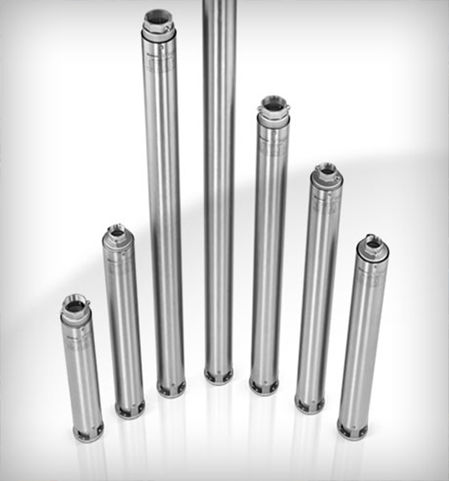
4-inch submersible pumps are compact pumping solutions designed particularly for borehole and deep well applications with specific diameter requirements. The term "4-inch" refers to the physical dimensions of this product category and the well configurations for which these pumps are suitable. They can be used in a wide range of applications, from agricultural irrigation and domestic water supply to commercial operations and various water transfer systems.
Although their compact design makes 4-inch submersible pumps practical for many well applications, selecting the right pump requires more than simply checking the well diameter. The required flow rate, head, well depth, dynamic water level, motor power, and water properties must be evaluated together. This ensures that a pump which physically fits inside the well also meets the hydraulic requirements of the system.
Compact dimensions, proper system selection.
Well diameter alone is not sufficient; hydraulic requirements and operating conditions must be evaluated together.
How Does a 4-Inch Submersible Pump Work?
The basic operating principle of 4-inch submersible pumps is similar to that of other multistage submersible pumps. Mechanical energy supplied by the submersible motor is transferred to the pump impellers. The rotating impellers transfer energy to the water, allowing it to move through successive stages and toward the discharge line.
The use of multiple pump stages helps generate the head required to lift the water. Since the pump operates completely submerged in water, it pressurizes water from its surrounding environment and pushes it upward rather than drawing water from the surface through suction. This configuration provides an effective solution, particularly for deep well applications.
Where Are 4-Inch Submersible Pumps Used?
One of the most common applications of 4-inch submersible pump systems is in drilled wells. They can be used in residential water supply, small and medium-scale agricultural irrigation, commercial facilities, and various water supply applications where groundwater must be brought to the surface. When the appropriate model is selected, these pumps can meet different depth and flow rate requirements.
However, the term "4-inch" alone does not indicate how much water a pump can transfer or at what depth it can operate. Models within the same physical diameter category may have different numbers of stages, motor power ratings, and performance characteristics. Therefore, pump selection should be based not only on product diameter but also on its performance curve.
Why Is Well Diameter Important?
The internal diameter of the well must be suitable for the safe installation of a submersible pump. Since the nominal diameter of the well casing may not always correspond to its actual internal diameter, verifying the real dimensions is particularly important in older wells or those with special configurations. The pump should be installed without excessive force and positioned correctly within the well.
Water movement around the pump can also be important for the motor's operating conditions. Therefore, simply ensuring that "the pump fits inside the well" is not sufficient. The manufacturer's installation and operating recommendations should be followed, and the mechanical and hydraulic characteristics of the system should be evaluated as a whole.
How Should the Required Flow Rate Be Determined?
When selecting a 4-inch submersible pump, the first step is to determine how much water the system requires. In agricultural irrigation, the irrigation system's capacity should be considered. For domestic water supply, water consumption requirements are important, while commercial applications require an evaluation of the facility's usage profile. Selecting a pump based solely on motor power without determining the required flow rate is not appropriate.
The amount of water the well can supply must also be considered. If the pump capacity significantly exceeds the well's sustainable yield, the water level may drop excessively and cause operational problems. Therefore, a balanced relationship must be established between pump capacity and well yield.
How Should Pump Head Be Evaluated?
The vertical distance through which the pump must lift water represents an important part of the required head, but it is not the only criterion. Friction losses within the pipeline and the pressure required at the point of use must also be taken into account. The combined effect of these factors determines the actual total head that the pump must overcome.
Friction losses should not be overlooked, particularly in applications involving long pipelines. The pump not only lifts water from the well but also supplies the energy required to move it through the piping system. Therefore, selecting a pump without calculating the actual required head may result in a lower flow rate than expected.
How Should Motor Power Be Selected?
The function of a submersible motor is to provide the mechanical energy required by the pump. Therefore, motor power must be selected according to the pump's operating point and power requirements. A motor with a higher power rating does not necessarily mean that the system will operate more efficiently.
Pump and motor combinations should be evaluated according to the manufacturer's technical specifications. Electrical factors such as power supply characteristics, control panels, protective devices, and cabling are also part of the system. Proper motor protection is just as important as selecting the right motor for reliable operation.
Why Are Water Quality and Sand Content Important?
Water extracted from drilled wells may not always be completely free of particles. Sand and abrasive materials in the water can cause wear on pump components over time. Therefore, the physical properties of the water should also be considered when evaluating well conditions.
The pump's materials and design characteristics must be suitable for its operating conditions. In applications where water quality is problematic, both the pump selection and the structural condition and operating characteristics of the well should be examined. A significant sand problem that remains unresolved at its source may also cause long-term damage to other equipment.
Why Should the Pump Performance Curve Be Examined?
Two submersible pumps belonging to the same diameter category may have completely different performance characteristics. One of the best ways to understand these differences is to examine the pump performance curve. The curve indicates the head that the pump can provide at specific flow rates, helping identify a model suitable for actual operating conditions.
The selected pump should ideally meet the required flow rate and head within an appropriate operating range. This approach helps prevent unnecessary oversizing and contributes to more balanced system operation. For this reason, the performance curve is an essential tool in professional pump selection processes.
How to Choose the Right 4-Inch Submersible Pump?
To make the correct selection, complete information about the well and the system must first be obtained. Well diameter, dynamic water level, target flow rate, total head, piping configuration, and water properties are the fundamental inputs in the selection process. Making a decision based solely on pump power or price without this information is not a reliable approach.
A properly selected 4-inch submersible pump can meet water demand reliably while helping keep energy consumption under control. The objective is not to use the largest or most powerful product but to identify the solution that provides the most suitable operating point for the system's actual requirements. This approach delivers the best results in terms of long-term performance and operational reliability.



Do Comment